

Mistletoe Meaning: Why We Kiss Under the Mistletoe at Christmas

Mistletoe is one of the oldest symbols of midwinter. Today most people know it for one thing: if two people meet under a sprig hung in a doorway at Christmas, they are expected to kiss. Behind that custom sits a much longer story of myths, healing plants and winter greenery, and a plant that is as interesting in nature as it is in folklore.
This guide explains what mistletoe symbolizes, the legends behind it, where kissing under the mistletoe actually began and how to use it safely at home. It is part of our flower meanings series. For other festive plants, see our Christmas flowers guide.
Mistletoe meaning at a glance
- Main meanings: love, romance and affection, along with peace, friendship and goodwill.
- Older meanings: fertility, vitality, healing, protection against evil and good luck, largely because it stays green through winter.
- At Christmas: a symbol of affection, welcome and a kiss shared under the doorway.
- Myth: in Norse mythology, mistletoe is tied to the death of the god Baldur and to his mother Frigg’s love.
- Pets: real mistletoe is poisonous. The ASPCA lists American mistletoe as toxic to dogs, cats and horses.
What is mistletoe?
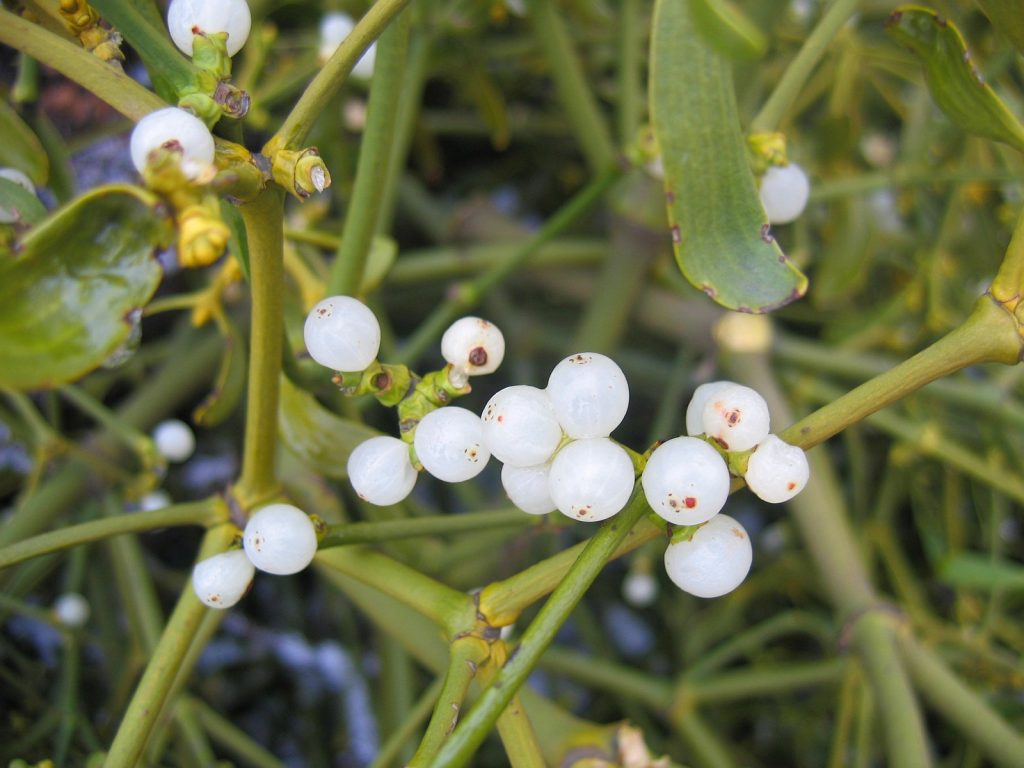
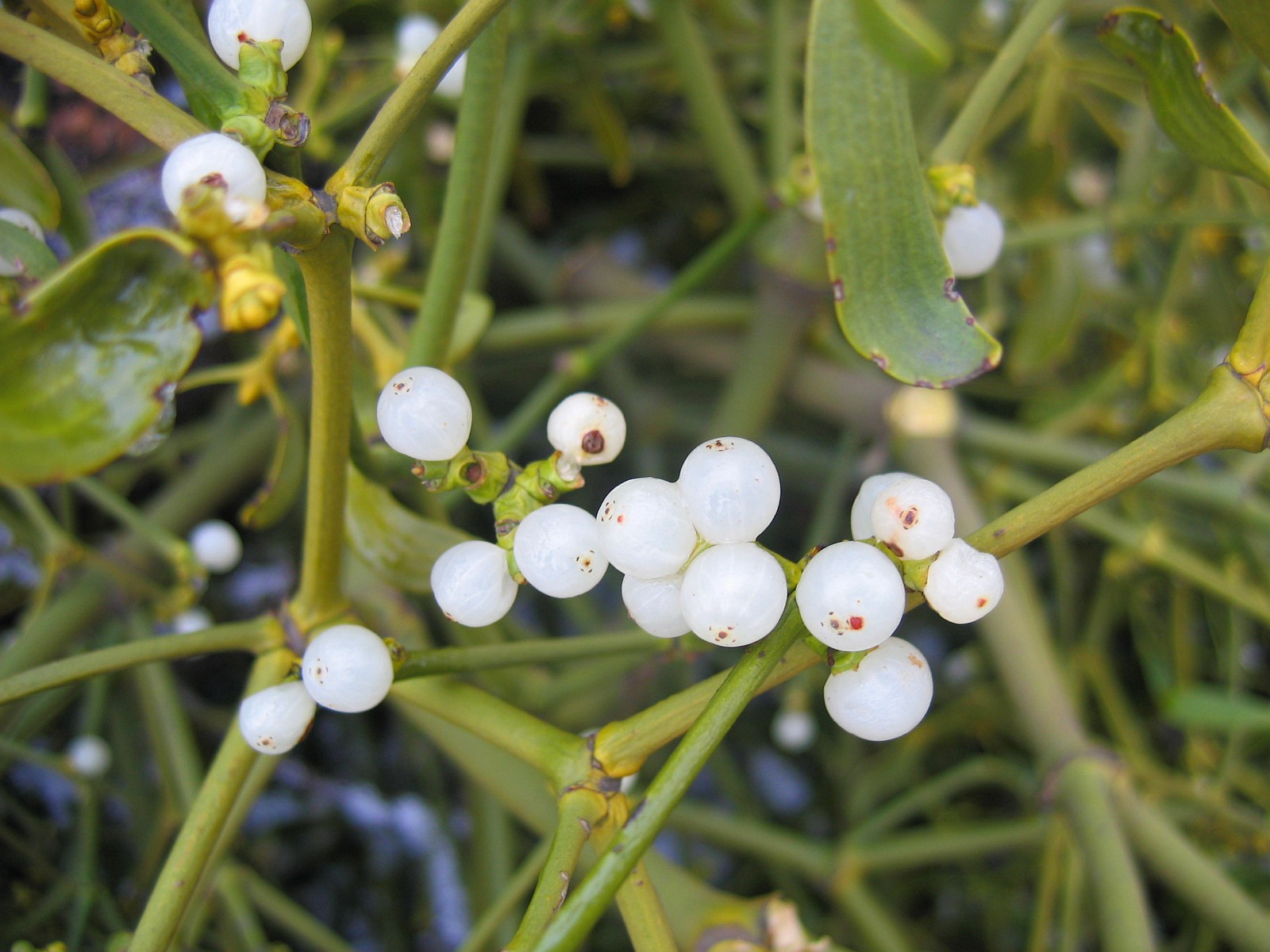
Mistletoe is a semi-parasitic evergreen that grows on the branches of trees rather than in the ground. The plant most linked with Christmas in Europe is European mistletoe, Viscum album. The Woodland Trust describes it as a small evergreen shrub that forms rounded clumps up to 1 meter (about 3 feet) wide in tree canopies, often in apple, lime (linden) and poplar trees. It makes some of its own food through photosynthesis but takes water and minerals from its host tree.
It has oval, leathery leaves in pairs and tiny flowers with four petals, and male and female flowers grow on separate plants. The waxy white berries appear from around October until May. Their seeds are coated in a sticky pulp that birds spread from tree to tree. In North America, mistletoe sold at the holidays is often American mistletoe, Phoradendron, a different plant with a similar look.
What does mistletoe symbolize?
Mistletoe gathered its meanings over many centuries. Because it stays green and bears berries in the middle of winter, when its host tree is bare, people saw it as a sign of life that survives the dark season.
- Love and romance: the meaning most people know today, thanks to the kissing custom.
- Peace and reconciliation: the Library of Congress notes that the Romans were said to settle their differences under mistletoe because it stood for peace. That is one reason a sprig over the door is also read as a sign of welcome and goodwill.
- Fertility and vitality: according to the Woodland Trust, mistletoe had an association with fertility and vitality right through to the Middle Ages.
- Healing and protection: the Woodland Trust says Druidic societies believed it protected against evil and cured disease.
- Good luck: the Library of Congress lists luck among the meanings the Celtic Druids gave it, because it could grow even in winter.
Mistletoe in Norse mythology
The best-known mistletoe legend comes from Norse mythology. As the Library of Congress retells it, Baldur, son of Odin, was prophesied to die. His mother, Frigg, made every plant and animal promise not to harm him, but she overlooked mistletoe. The trickster Loki made an arrow from it, and Baldur was killed.
The story has different endings. In one, Baldur is brought back to life and Frigg declares mistletoe a symbol of love, promising to kiss everyone who passes beneath it. In another, her tears become the white berries, and she vows the plant will never again be used as a weapon. Smithsonian Magazine sums it up: after Baldur’s death, mistletoe becomes linked with his grieving mother’s undying love. These links are later retellings, though, not proof that the kissing custom came from Scandinavia.
The Druids and mistletoe
The oldest written account of mistletoe rituals comes from the Roman author Pliny the Elder in the first century. He wrote that the Druids of Gaul held nothing more sacred than mistletoe growing on an oak. A priest in a white robe climbed the tree and cut it with a golden sickle, and the Druids believed a drink made from it would make barren animals fertile and act as an antidote to poisons.
English Heritage adds a useful caution. Pliny wrote about Gaul, roughly modern France, and did not mention Britain or the time of year. Victorian historians assumed the Druids also gathered mistletoe in Britain at Christmas, but that link is not in Pliny’s original text.
Why do we kiss under the mistletoe?
Nobody knows exactly how the kissing custom started, but its written history is fairly recent:
- 1600s: English Heritage says the poet Robert Herrick (1591 to 1674) is the first person known to connect mistletoe with Christmas, in his poem “Ceremonie upon Candlemas Eve”.
- 1784: the earliest known reference to kissing under the mistletoe appears in a song from the English play Two to One, in which young men “kiss beneath the mistletoe”.
- 1819 to 1820: the American writer Washington Irving described English Christmas customs in which young men could kiss the girls under the mistletoe, “plucking each time a berry from the bush. When the berries are all plucked, the privilege ceases.”
- Kissing boughs: English Heritage notes that earlier homes hung kissing boughs, hoops decorated with greenery and ornaments, and that a similar berry-for-a-kiss rule may explain today’s tradition.
The Woodland Trust still repeats the old rule: remove a berry for every kiss claimed. Smithsonian Magazine points out that most mistletoe decorations today are artificial, often with red berries even though real European mistletoe berries are white.
Mistletoe etiquette today
A kiss under the mistletoe should always be welcome. Treat it as a playful invitation rather than an obligation. Today a sprig of mistletoe is just as often read as a sign of friendship, welcome and peace, which makes it a good fit for a front door or entrance hall at Christmas.
How to use mistletoe at home
- Hang it high: a doorway or the center of a ceiling is traditional, tied with a red or white ribbon.
- Pair it: mistletoe sits well with holly, ivy and evergreens in a Christmas arrangement or wreath. Holly is also one of the December birth flowers.
- Consider artificial: in homes with pets or small children, a realistic artificial sprig gives the look without the risk.
- Enjoy it outdoors: the Woodland Trust notes that wild mistletoe is food and habitat for birds and insects, and suggests enjoying it in its natural setting where you can.
Is mistletoe poisonous to pets and people?
Yes, real mistletoe should be treated as poisonous. The Woodland Trust says the leaves, stems and berries of European mistletoe are all poisonous. The ASPCA lists American mistletoe as toxic to dogs, cats and horses, with signs including vomiting, diarrhea, difficulty breathing, a slow heart rate and, rarely, low blood pressure. Hang it well out of reach and pick up any fallen berries or leaves. If a pet eats any, call your vet or the ASPCA Animal Poison Control Center straight away.
For pet-safer holiday choices, a Christmas cactus or a moth orchid (see how to care for an orchid) are both listed by the ASPCA as non-toxic to cats and dogs. Our guides to flowers safe for cats and flowers safe for dogs have more ideas.
Keep exploring
Discover the meaning of other festive plants in our guides to poinsettia meaning, amaryllis meaning and December birth flowers, including holly. For romantic flowers year round, see flowers that mean love and rose meaning, or browse the full flower meanings list. For the holidays, see Christmas plants safe for pets. For another Christmas legend, see Christmas rose meaning.
Frequently asked questions
Today mistletoe mainly symbolizes love, romance and affection, as well as peace, friendship and goodwill. Older traditions also linked it with fertility, vitality, healing, protection and good luck, because it stays green in winter.
No one knows exactly how it started. The earliest known reference to kissing under mistletoe is in an English song from 1784, and by around 1820 Washington Irving described young men plucking a berry from the mistletoe for each kiss until none were left.
In Norse mythology, the god Baldur was killed by an arrow made of mistletoe, the one plant his mother Frigg had not asked to spare him. In later retellings, Frigg made mistletoe a symbol of love and promised a kiss to anyone who passed beneath it.
Yes. European mistletoe leaves, stems and berries are poisonous, and the ASPCA lists American mistletoe as toxic to dogs, cats and horses. Hang it out of reach of pets and children.
Real European mistletoe has white berries. Red berries on holiday mistletoe are usually artificial decorations.
Sources
- Woodland Trust: Mistletoe (Viscum album)
- Library of Congress: Highlighting the holidays: under the mistletoe
- Smithsonian Magazine: How mistletoe became a Christmas kissing tradition
- English Heritage: Why do we bring plants and trees inside at Christmas time?
- Pliny the Elder, Natural History, Book 16, chapter 95 (Perseus Digital Library)
- ASPCA: American mistletoe