

How to Identify Flowers: A Beginner’s Guide (and When to Trust an App)

Whether it’s a wildflower on a walk, something new in the garden or a stem in a bouquet you were given, putting a name to a flower is satisfying. It is also the first step to finding out what the flower means, how to care for it and whether it is safe around children and pets.
This guide covers the features to look at first, a few plant family patterns that narrow things down quickly, and how to use identification apps sensibly. It draws on plant identification guidance from Washington State University and NC State Extension, and on a 2023 study of identification app accuracy. It is part of our flower care and learning guides.
Start with what you can see
Botanists identify plants by features that can be described and compared, as Washington State University’s gardener’s handbook explains. For flowers, a handful of questions does most of the work. A widely used approach, from Newcomb’s Wildflower Guide, starts with these:
- Symmetry: is the flower regular (radially symmetrical, like a daisy or a buttercup) or irregular (with a distinct top and bottom, like a snapdragon or a pea flower)?
- Number of parts: if it is regular, how many petals or petal-like parts does it have? Three, four, five, six or many?
- Leaf arrangement: are the leaves alternate (staggered up the stem), opposite (in pairs facing each other), whorled (three or more at the same point) or all at the base?
- Leaf edges: are the leaf margins smooth, toothed, lobed or divided into separate leaflets?
- Plant type: is it a non-woody plant, a shrub or a vine?
Also note the color, scent, height, how the flowers are grouped on the stem, the habitat and the time of year. A flower photographed in a damp meadow in June narrows the possibilities a lot compared with “a purple flower”.
Plant family clues
Some features point to a whole plant family, which gets you most of the way to an answer. WSU gives square stems in the mint family as an example. A few other well-known patterns:
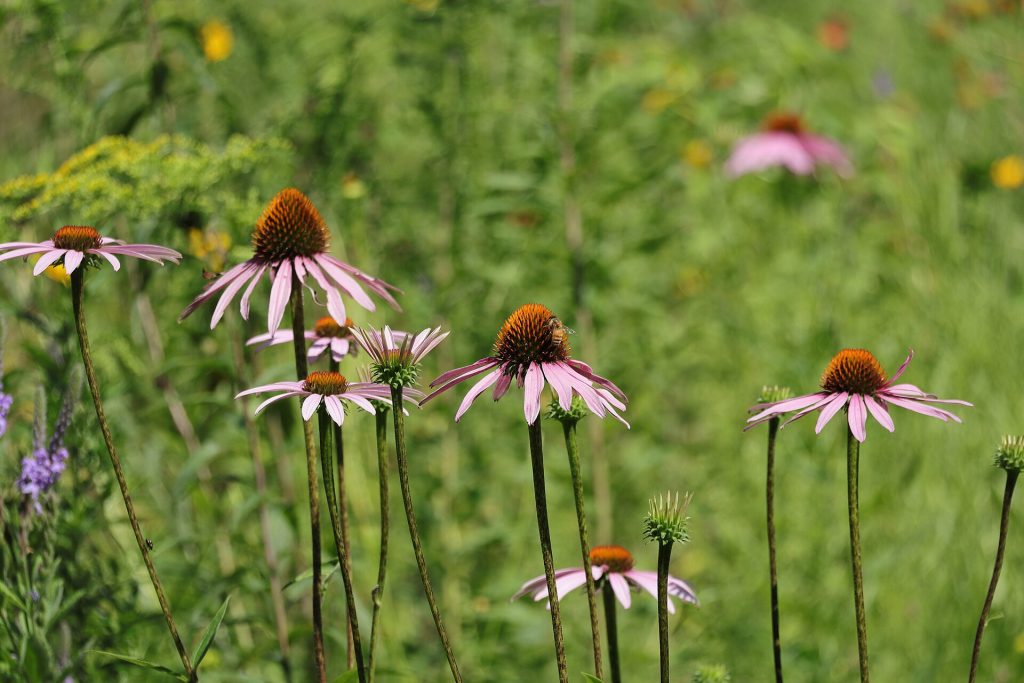
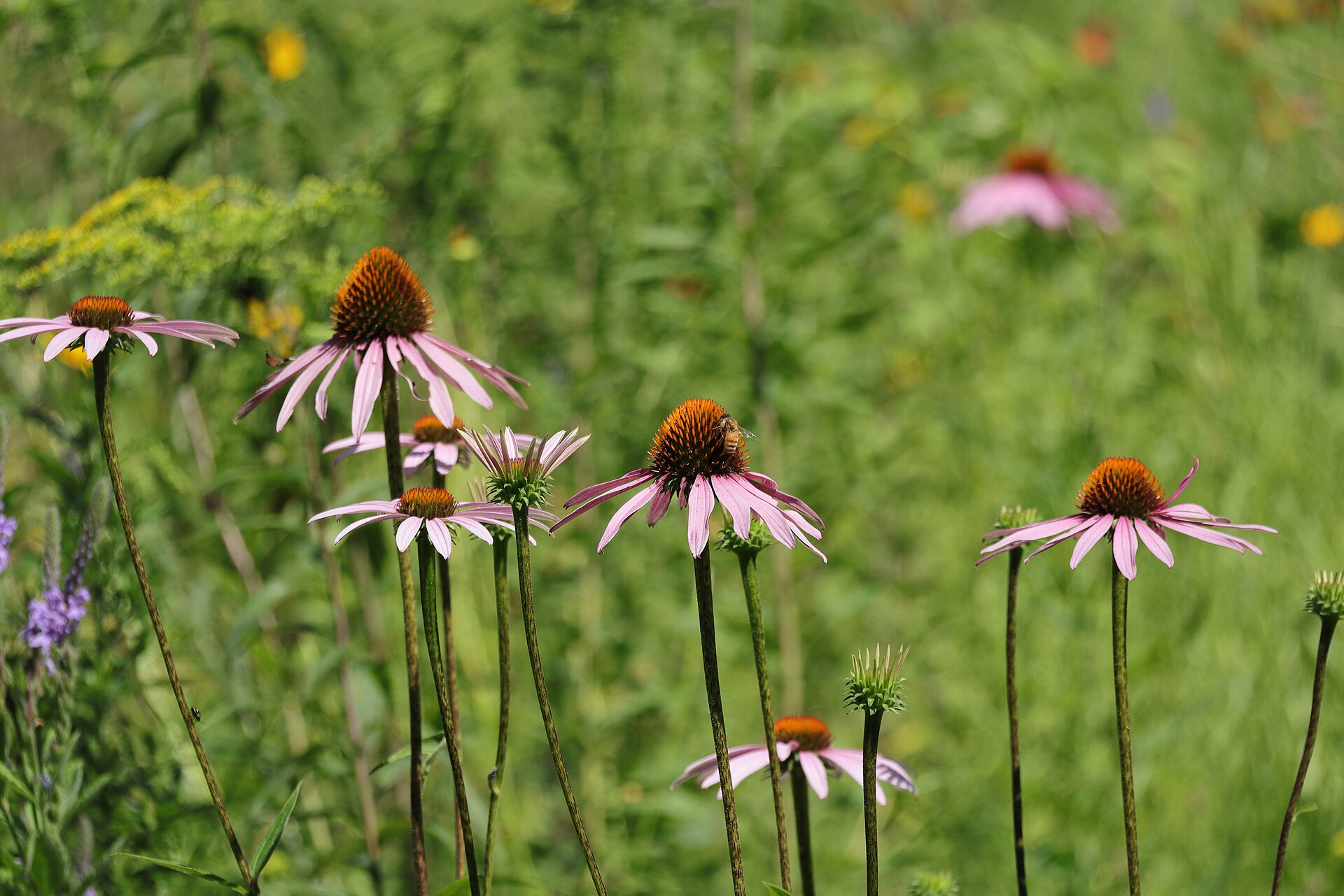
- Daisy or aster family: what looks like a single flower is really a head of many tiny flowers packed together. Daisies, sunflowers, asters, zinnias, marigolds and chrysanthemums all work this way.
- Mint family: square stems, leaves in opposite pairs and often a strong scent when crushed. Lavender is a member.
- Mustard family: four petals arranged in a cross.
- Pea family: irregular flowers with a large upper petal, two side petals and a lower boat-shaped pair, like sweet peas and lupines.
- Carrot family: many small flowers in flat-topped umbrella-shaped clusters called umbels. Take care with this family: it includes highly poisonous plants such as poison hemlock and water hemlock.
- Lilies and similar plants (monocots): flower parts in threes or sixes and leaves with parallel veins, as in lilies, tulips and irises.
Using flower identification apps
Photo apps have made identification far easier. NC State Extension names a few: iNaturalist (especially useful for wild plants), PlantNet, Google Lens and the Look Up feature on iPhones. Its tips for a good result:
- Take a clear, close-up photo of the flower and also of the leaves.
- Turn on location data, since apps use it to narrow down what grows in your area.
How accurate are they? A 2023 study in the journal People and Nature tested five free apps on 857 professionally identified photos of 277 plant species. Across all apps, the first suggestion was right for 69% of the photos, and the right answer was somewhere in the top five suggestions for 85%. Accuracy varied a lot between apps and plant types. The authors concluded that free apps are useful tools, with some caveats.
That matches NC State’s advice: treat an app’s answer as provisional until you can confirm it with a field guide, an identification key or an expert. WSU recommends the same: check an app’s suggestion against an identification key or other reliable sources. A good habit is to compare the top suggestions with photos and descriptions from a regional field guide, and to check features the app can’t see, such as scent or stem shape.
Identifying flowers in a bouquet
Florist flowers are usually easier than wildflowers, because a relatively small number of flowers make up most bouquets: roses, tulips, lilies, carnations, chrysanthemums, alstroemeria, gerberas, hydrangeas, baby’s breath and a few others. Our flower meanings guide has an A to Z of popular flowers with photos, and our list of 85 types of flowers covers many more. Some look-alikes worth knowing:
- Alstroemeria vs. lilies: alstroemeria, or Peruvian lily, has smaller flowers with streaked inner petals, and several blooms on each branching stem. Read the alstroemeria and lily guides.
- Ranunculus vs. roses and peonies: ranunculus have tightly layered, paper-thin petals and a smaller, rounder shape. See ranunculus.
- Carnations vs. small roses: carnations have frilled, ruffled petal edges. See carnations.
- Gerberas vs. daisies: both belong to the daisy family, but gerberas are larger and come in bold colors. See gerbera and daisy.
Once you know what is in your vase, you can look up how to care for it, starting with our guide to keeping cut flowers fresh.
Stay safe
- Never eat a plant or use it as a remedy based on an app’s identification. Many toxic plants have harmless look-alikes.
- Check pet safety before bringing an unfamiliar plant indoors. The ASPCA keeps a searchable list of toxic and non-toxic plants. Lilies, for example, are dangerous for cats.
- Leave wildflowers where they grow unless you know picking is allowed. Many parks and nature reserves prohibit it, and some species are protected.
- Take care with sap: some plants cause skin irritation. Wash your hands after handling an unfamiliar plant.
Keep exploring
Wondering what your flower means? Browse our flower meanings. Looking for the flower for someone’s birth month? See birth flowers by month. Or choose a bouquet for an occasion in what flowers to send.
Frequently asked questions
Take clear photos of the flower and its leaves and run them through an identification app such as iNaturalist or PlantNet, then confirm the suggestion with a field guide. Note symmetry, petal count and leaf arrangement as you go.
They are useful but not perfect. A 2023 study in People and Nature found the first suggestion was right for 69% of photos across five free apps, and the right answer was in the top five for 85%.
Start with the symmetry, the number of petals, how the leaves are arranged on the stem, the leaf edges and whether the plant is a non-woody plant, shrub or vine. Then add color, scent, habitat and season.
Most bouquets use a short list of popular flowers. Compare yours with the photos in a flower guide, such as our flower meanings A to Z, or use a photo app.
No. Never eat a plant or use it as a remedy based only on an app or photo identification. Many poisonous plants look like harmless ones.
Sources
- Washington State University Extension: Plant nomenclature and identification (Pacific Northwest Gardener’s Handbook)
- NC State Extension: Identify a plant
- Vassar College: Plant identification fact sheet (Newcomb’s five questions)
- Hart et al. (2023), Assessing the accuracy of free automated plant identification applications, People and Nature
- ASPCA: Toxic and non-toxic plants