

Sympathy and Funeral Flowers: What to Send and What to Avoid

When someone dies, it can be hard to know what to say. Flowers have long been a way to say it for you. The Emily Post Institute describes them as “grace notes during the mourning period”, whether at the visitation, the funeral, the graveside or the family’s home.
Getting sympathy flowers right is mostly about thoughtfulness rather than rules. This guide covers which flowers and colors to choose, where and when to send them, cultural customs to be aware of, what to write on the card and how to make sure your flowers are safe for a home with pets. It is part of our what flowers to send guide. If you are sending flowers to the family’s home rather than to the service, see our guide to sympathy flowers for the home.
Sympathy flowers at a glance
- Classic choices: white lilies, white roses, carnations, chrysanthemums and orchids.
- Colors: white and soft pastels are traditional, but bright flowers can celebrate a life.
- Where to send: the funeral home or place of worship for the service, or the family’s home.
- When: as soon as possible, and in time for the visitation or funeral.
- Check first: the obituary for “in lieu of flowers”, and the family’s religious customs.
The best flowers for sympathy, and why
The Emily Post Institute notes that roses, lilies, carnations and other traditional flowers have never gone out of style, and that virtually any flower or plant is suitable for friends and coworkers to send, especially one that reflects the personality of the person who died.
- Lilies: white lilies stand for purity and are one of the most traditional funeral flowers. Avoid them if the family has cats (see pet safety below).
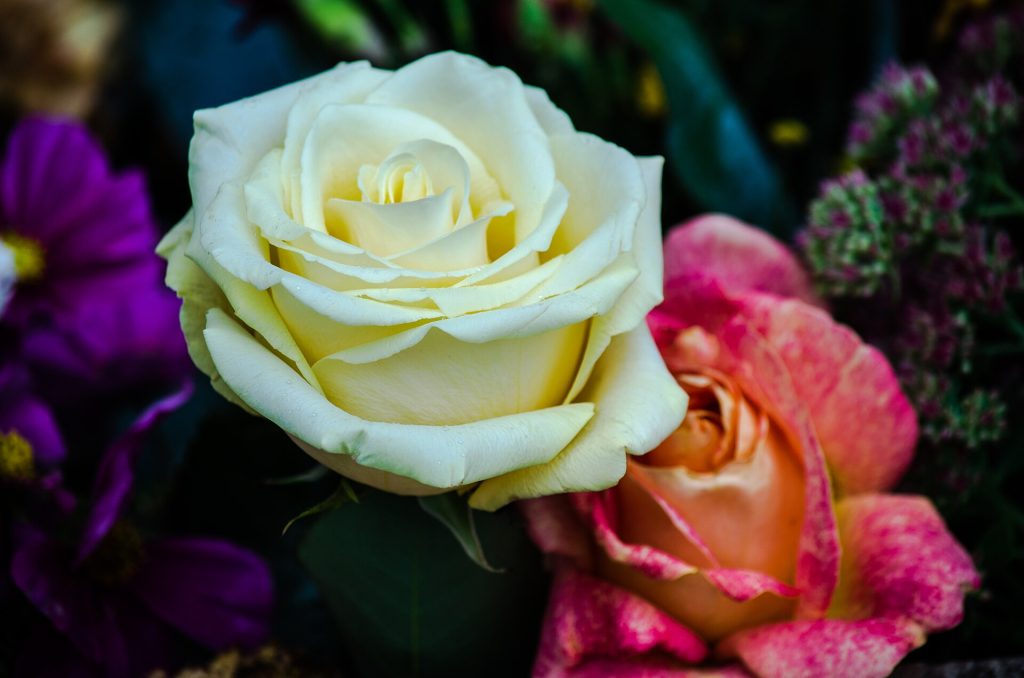
- Roses: The Old Farmer’s Almanac gives white roses the meaning of reverence and new beginnings, and Interflora describes white roses as a way to say “I’m thinking of you”. In the Victorian language of flowers, very dark crimson roses meant mourning.
- Carnations: long-lasting, and white carnations traditionally honor a mother who has died.
- Chrysanthemums: Interflora notes that, because they are associated with mourning and remembrance in parts of Europe, white chrysanthemums are still chosen for funeral sprays and memorial flowers.
- Orchids and living plants: a potted white orchid keeps flowering for weeks, which makes it a quiet, lasting gift for the family home.
- Hydrangeas: soft white or pale blue hydrangeas fill an arrangement generously.
Choosing colors
White is the traditional color of sympathy and remembrance, and soft pastels feel gentle and calm. But there is no rule that sympathy flowers must be white. If the person loved bright colors or a particular flower, sunflowers or a mixed bouquet in their favorite shades can be a warm tribute. Interflora describes sunflowers as a way to offer support during tough times, with meanings that include resilience and hope.
Which arrangement, and who sends it
The Emily Post Institute gives a helpful guide to who usually sends what:
- Bouquets, baskets and living plants: friends, coworkers and relatives, sent to the family’s home, workplace or the funeral home.
- Wreaths, crosses and sprays: often sent by a group, a company or an association, and displayed at the funeral home or service.
- Floral tributes: close friends or family, sometimes in a personalized design that reflects the person’s work, clubs or hobbies.
- Casket sprays: usually provided by the immediate family.
If you are unsure, a bouquet or plant sent to the family’s home is always appropriate.
What to avoid, including cultural customs
- Ignoring “in lieu of flowers”: if the obituary asks for donations instead, the Emily Post Institute advises following the family’s wishes. You can still send flowers as well, but if you are sending only one expression of sympathy, choose the donation.
- Flowers for a Jewish funeral or shiva: according to Shiva.com, flowers are typically not part of Jewish mourning tradition, and as a general rule you should not send flowers or wreaths to a Jewish funeral or to a shiva home. Food or a charitable donation is a more appropriate gesture.
- Russian customs: the Cultural Atlas notes that in Russia an uneven number of flowers is given for every occasion except a funeral, and that carnations are associated with funerals. If you are unsure of the right count for a Russian family, ask the florist or a family friend.
- Chrysanthemums in Italy and parts of Europe: they symbolize death and are used at funerals, according to the Cultural Atlas and Interflora. That makes them appropriate for sympathy but a poor choice for any other occasion there.
- White flowers in East Asian cultures: the Cultural Atlas notes that in Japan lilies, lotus flowers, camellias and white flowers are usually associated with funerals. Customs vary between families and faiths, so if in doubt, ask the funeral director or a close family member. For a fuller guide, see funeral flowers by religion.
Pet safety
Many grieving families have pets, and the last thing they need is a vet emergency. The ASPCA lists true lilies (Lilium) as highly toxic to cats, and the US Food and Drug Administration warns that even small amounts, including pollen or water from the vase, can cause kidney failure in cats. If the family has a cat, avoid lilies entirely.
The ASPCA also lists chrysanthemums, carnations and hydrangeas as toxic to dogs and cats, though they usually cause stomach upset rather than life-threatening illness. Roses, orchids (Phalaenopsis), Peruvian lilies (alstroemeria) and snapdragons are all listed as non-toxic, so a white rose and orchid arrangement is a good pet-safe choice.
Budget guidance
There is no expected amount to spend on sympathy flowers. A modest bouquet sent with care means as much as a large arrangement. A few practical points:
- Large standing sprays and casket pieces cost the most and are usually left to the family or a group.
- If several colleagues or friends want to send something, pooling money for one arrangement is a common and welcome approach. The Emily Post Institute suggests signing the card as the group, such as “The Sixth Street Book Club”.
- If you choose a donation instead, the Emily Post Institute suggests giving at least what you would have spent on flowers.
- Seasonal flowers and living plants often give the best value and last longest.
Delivery timing
The Emily Post Institute says there are no rules for timing, but it is good to get flowers to the bereaved as soon as possible, and to the funeral home or place of worship in time for the visitation or funeral. Some close friends send flowers to the home over the following months as a reminder that they are still thinking of the family, which can be especially welcome in the quieter weeks after the funeral.
When sending to a funeral home, include the full name of the person who died and the date and time of the service, and check the funeral home’s delivery hours. Keep the card simple so the family can easily record who sent what. Emily Post notes that someone will usually keep a list so the family can send thank-you notes.
Card message ideas
Keep sympathy card messages short, sincere and focused on the person who died or on the family. Some ideas:
- “With deepest sympathy. We are thinking of you all.”
- “Remembering [name] with love.”
- “So sorry for your loss. [Name] will be greatly missed.”
- “Holding you close in our thoughts.”
- “With love and sympathy, and wonderful memories of [name].”
- For a group: “With heartfelt condolences from all of us at [team or group name].”
If you knew the person well, a short memory, such as “I’ll never forget [name]’s laugh”, can mean a great deal.
Keep exploring
Read more about lily meanings, rose meanings, chrysanthemum meanings and forget-me-not meanings, See also funeral flowers by religion and what to write on funeral flowers, or what flowers to send for every occasion.
Frequently asked questions
White lilies, white roses, carnations, chrysanthemums and orchids are traditional, but almost any flower is suitable, especially one the person who died loved.
Either is fine. Send flowers to the funeral home or place of worship in time for the service, or a bouquet or plant to the family’s home.
It means the family would prefer a donation, usually to a named charity, instead of flowers. Follow their wishes if you are sending only one gift.
Generally no. Flowers are not usually part of Jewish mourning tradition. Food or a charitable donation is more appropriate for a shiva home.
No. True lilies are highly toxic to cats, and even pollen or vase water can cause kidney failure. Choose roses or orchids instead.
Sources
- Emily Post Institute: Sympathy flowers
- Emily Post Institute: Donations in lieu of flowers
- Shiva.com: Flowers and the Jewish mourning tradition
- Cultural Atlas: Russian etiquette
- Cultural Atlas: Italian etiquette
- Cultural Atlas: Japanese etiquette
- Interflora: Chrysanthemum guide
- Interflora: Sunflower guide
- The Old Farmer’s Almanac: Flower meanings
- ASPCA: Lily
- FDA: Lovely lilies and curious cats
- ASPCA: Cats plant list