

Flowers That Mean Strength: 12 Blooms for Courage and Resilience

Sometimes the message you want to send is not “congratulations” or “I love you” but “you can do this”. A friend facing surgery, a colleague starting treatment, a family member getting through a loss, or someone heading into the biggest exam of their life. Flowers that mean strength let you say that quietly, without having to find perfect words.
This guide covers 12 flowers, herbs and leaves linked with strength, courage and resilience, where those meanings come from, which ones suit which situation and what to write on the card. It is part of our flower meanings series, alongside flowers that mean new beginnings and flowers that mean friendship.
Flowers that mean strength at a glance
- The classic strength flower: the gladiolus, which The Old Farmer’s Almanac links with strength, integrity and victory.
- For courage: proteas, edelweiss, irises and thyme.
- For resilience: snowdrops, carnations, lotus flowers and proteas, which regrow after fire in the wild.
- For strength with a softer look: snapdragons, which Interflora links with strength and grace, and orchids, which it links with strength and vitality.
- Pet-friendly picks: snapdragons, moth orchids and thyme are listed as non-toxic to dogs and cats by the ASPCA.
12 flowers that mean strength
1. Gladiolus. The flower most often named for strength. The Almanac’s chart of Victorian flower meanings calls it the “flower of the gladiators” and gives it the meanings integrity, strength and victory, and Interflora says gladioli are traditionally associated with strength of character. The name comes from the Latin gladius, a sword, after the plant’s blade-shaped leaves. Its tall, upright spikes look the part, too. Gladiolus is an August birth flower. The ASPCA lists it as toxic to dogs and cats.
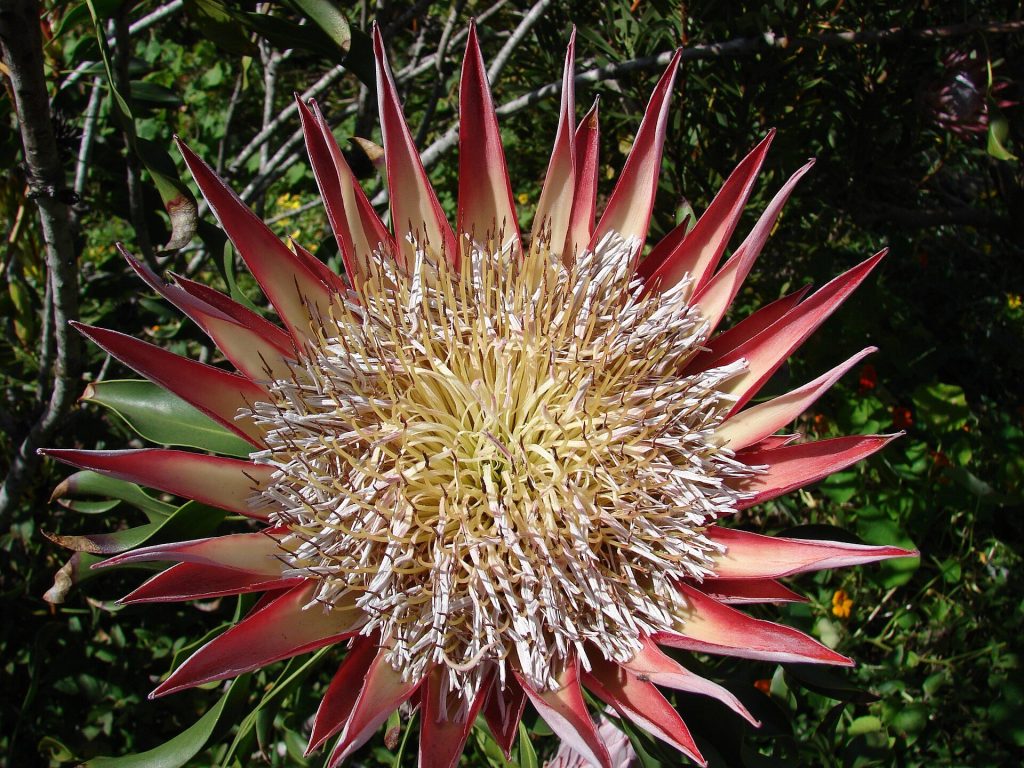
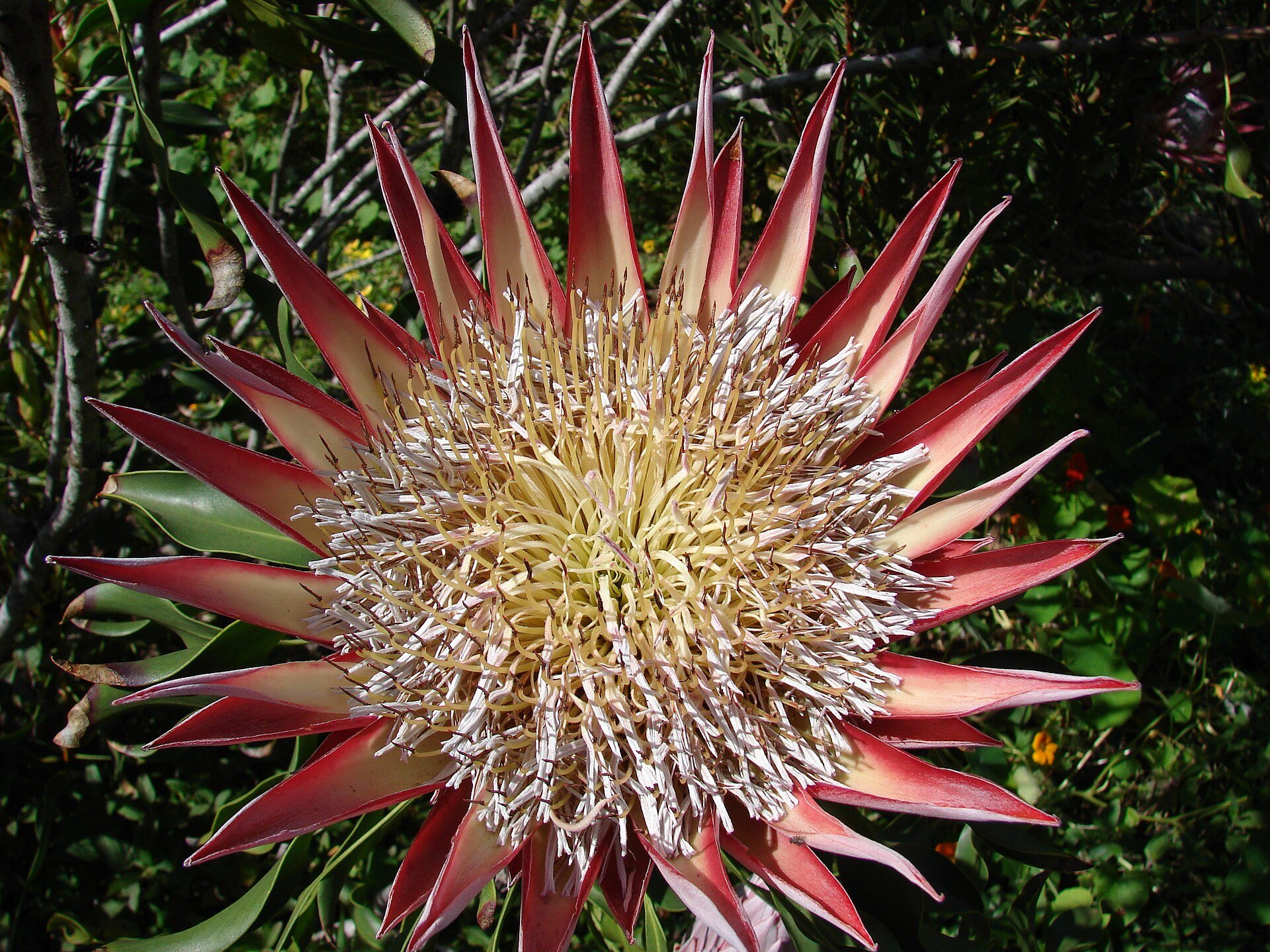
2. Protea. Interflora links proteas with strength and courage, and the plant’s story backs that up. The king protea (Protea cynaroides) is South Africa’s national flower. According to the South African National Biodiversity Institute (SANBI), it grows in fire-prone vegetation where natural fires happen every ten to thirty years, and survives them thanks to a thick underground stem full of dormant buds that produce new growth after the fire. SANBI also explains that the genus was named after the Greek god Proteus, who could change his shape at will. Proteas last well and can be dried, so the gift keeps going. Proteas are not on the ASPCA’s plant list, so ask your vet if your pet is a chewer.
3. Snapdragon. Interflora’s flower meanings table gives snapdragons “strength and grace”. The Victorian lists are less flattering: the Almanac gives them both graciousness and deception, so if you include a note, lean on the modern meaning. Snapdragons are tall, colorful and long-lasting in a vase, and the ASPCA lists the common snapdragon as non-toxic to dogs and cats.
4. Edelweiss. The Almanac gives edelweiss the meanings courage and devotion, and Switzerland’s Federal Department of Foreign Affairs describes it as a symbol of purity and courage that is seen as a true national emblem in Switzerland. The name comes from the German edel (noble) and weiss (white). Its image as a flower that only brave climbers could reach is partly a legend: a University of Zurich researcher quoted by the Swiss government says it was alpinists themselves who popularized the idea, to present themselves as brave, strong men. Edelweiss is not a florist’s flower, so it works best as a garden plant, a pressed flower or a design on a card. It is not on the ASPCA’s plant list.
5. Iris. In the Almanac’s chart, the iris stands for faith, trust, wisdom, hope and valor, which makes it a good choice when you want to send courage and hope together. Deep blue and purple irises look striking in a simple vase. The ASPCA lists irises as toxic to dogs and cats.
6. Lotus. The Almanac lists the lotus as a symbol of purity, enlightenment, self-regeneration and rebirth. It grows from muddy water and opens a clean bloom above the surface, which is why it is so often used as a picture of coming through hard times. Dried lotus seed pods are also popular in arrangements. The lotus is not on the ASPCA’s plant list.
7. Snowdrop. Snowdrops push up through snow and frozen ground in late winter. Interflora calls them “a powerful emblem of resilience and perseverance” and says they symbolize hope, renewal and the promise of brighter days. They are one of the January birth flowers, and a pot of snowdrop bulbs is a lovely gift for someone having a hard winter. Snowdrops are not on the ASPCA’s plant list.
8. Carnation. Interflora says the carnation’s long-lasting blooms symbolize resilience and endurance, which makes them the other half of January’s birth flower pairing. They live up to it in the vase: University of Illinois Extension says carnations can last up to two weeks. The ASPCA lists carnations as toxic to dogs and cats, usually causing mild stomach upset.
9. Orchid. Interflora suggests orchids for get well wishes because they signify strength and vitality. A potted moth orchid (Phalaenopsis) flowers for weeks with very little care, which makes it ideal for someone on a long recovery at home. The ASPCA lists moth orchids as non-toxic to dogs and cats. See how to care for an orchid.
10. Thyme. The Almanac gives thyme the meanings courage and strength, a meaning that goes well beyond the kitchen. A few sprigs tucked into a bouquet add scent and texture, or you can give a potted thyme plant to a keen cook. The ASPCA lists thyme as non-toxic to dogs and cats.
11. Oak leaves. The Almanac lists oak simply as “strength”. Oak leaves are not flowers, but autumn oak foliage is a handsome background for a fall bouquet, and a small oak sapling is a lasting gift for someone starting over. Oak is not on the ASPCA’s plant list, so keep acorns and leaves away from pets that chew.
12. Nasturtium. In the Victorian chart, nasturtiums stand for patriotism, conquest and victory in battle. These bright orange, red and yellow garden flowers are a cheerful choice for a gardener, and a packet of seeds or a small pot makes a simple gift. The ASPCA lists the garden nasturtium (Tropaeolum majus) as non-toxic to dogs and cats.
Strength, courage or resilience: which message do you mean?
- Strength of character for someone you admire: gladiolus, oak leaves.
- Courage before something frightening, like surgery, a deployment or a big performance: protea, edelweiss, iris, thyme.
- Resilience for someone getting through a long, hard stretch: snowdrops, carnations, lotus, protea.
- Gentle strength for someone who is unwell or tired: snapdragons, a moth orchid.
- Victory for someone who has made it through: gladiolus, nasturtium.
Which strength flowers to send, and when
Illness and recovery. Choose something easy to care for. A moth orchid is the classic choice, and a mixed bunch of snapdragons and carnations lasts well. Many hospitals restrict flowers on some wards, so check before you send. See get well soon flowers.
Grief and loss. Gladioli are common in sympathy arrangements, and white snapdragons and carnations are calm, simple choices. See sympathy flowers for what to send to a family’s home.
A big challenge. Interflora suggests gladioli for good luck and encouragement before an interview, an exam or a first day at a new job, and notes that sunflowers add a bright, optimistic feel.
Celebrating someone who got through it. A bold protea or a tall bunch of gladioli says “you did it”. If the next step is a fresh start, mix in some flowers that mean new beginnings.
For him. Proteas, gladioli and irises all have the strong shapes and colors that suit flowers for men.
Bouquet ideas that say “stay strong”
- Tall and upright: gladioli with snapdragons, both spike flowers that give a bouquet height.
- Bold and lasting: one or two king proteas with long-lasting foliage, which can be dried afterward.
- Quiet and hopeful: white carnations with a few sprigs of thyme.
- A plant that keeps going: a potted moth orchid, or a pot of snowdrop bulbs in late winter.
- Courage in blue: deep blue irises on their own. See blue flowers meaning for more blue blooms.
Flowers to think twice about
Most flowers are fine for a “stay strong” bouquet, but a few old meanings are worth knowing. In the Victorian chart, the tall sunflower meant haughtiness and the begonia meant “beware”, although today most people see sunflowers as a sign of joy and hope. Snapdragons carry deception as well as graciousness in the old lists. None of these will offend anyone who does not know the language of flowers, but if the recipient does, add a card that makes your meaning clear.
What to write on the card
- “Thinking of you and sending all my strength.”
- “You are stronger than you know. I am here whenever you need me.”
- “One day at a time. We are all rooting for you.”
- “These gladioli stand for strength, and they made me think of you.”
- “So proud of how you have handled everything this year.”
Pet safety
According to the ASPCA’s toxic and non-toxic plants lists, snapdragons, moth orchids, thyme and garden nasturtiums are non-toxic to dogs and cats. Gladioli, irises and carnations are listed as toxic. Proteas, edelweiss, snowdrops, lotus and oak are not on the ASPCA list, so ask your vet if you are unsure. If your pet eats any plant and seems unwell, call your vet or the ASPCA Animal Poison Control Center on (888) 426-4435 (a fee may apply). See flowers safe for cats and flowers safe for dogs.
Keep exploring
Find more meanings in flowers that mean love, flowers that mean friendship and flowers that mean new beginnings, browse what flowers to send for every occasion, or look up any bloom in our flower meanings list.
Frequently asked questions
The gladiolus is the flower most often linked with strength. The Old Farmer’s Almanac gives it the meanings strength, integrity and victory, and Interflora says it is associated with strength of character. Proteas and snapdragons are also linked with strength.
Snowdrops are a good choice: Interflora calls them an emblem of resilience and perseverance because they push through snow and frozen ground. Carnations, lotus flowers and proteas, which regrow after wildfires, are also linked with resilience.
Edelweiss, proteas, irises and thyme. The Almanac gives edelweiss the meanings courage and devotion, thyme courage and strength, and the iris valor, while Interflora links proteas with strength and courage.
Easy-care flowers that last are best. A potted moth orchid, which Interflora links with strength and vitality, or a mixed bunch of snapdragons and carnations both work well. Add a short, warm card so your meaning is clear.
The ASPCA lists snapdragons, moth orchids, thyme and garden nasturtiums as non-toxic to dogs and cats. Gladioli, irises and carnations are listed as toxic, so keep those out of reach.
Sources
- The Old Farmer’s Almanac: Flower meanings, the language of flowers
- Interflora: Flower meanings
- Interflora: January birth flowers
- Interflora: Orchid guide
- SANBI PlantZAfrica: Protea cynaroides
- South African Government: National flower
- Swiss Federal Department of Foreign Affairs: The mystical and mythical edelweiss
- University of Illinois Extension: Help your Valentine’s flowers last longer
- ASPCA: Toxic and non-toxic plants